Tuesday, February 2, 2016

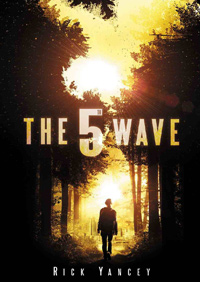
The 5th Wave by Rick Yancey

(In which humanity ain't got no Jedi knights.)


***
I did it again.

Saw a cool trailer.


And another cool trailer.


Watched the movie. And then read the original novel.

In the beginning, I didn't really watch the movie because of the plot since I am not that fond of alien-related movies. In fact, I have just watched Star Wars episode 1 to 6 in December -- just in time before the seventh episode came out, because, FOMO maybe? But what really got me to watch The 5th Wave is -- wait for it -- Nick Robinson. 


Maybe another reason why I read the novel was FOMO, or Nick Robinson -- or maybe both.

The premise of the novel wasn't really something extraordinary. In fact, it's somehow been a formula: aliens attack Earth, Earthlings defend it (or try to), a war ensues, and more often than not, the Earthlings win. Put in some romance and a lot of gory death, and you've got just another alien movie.

Unless this one's not just another alien movie.

In most fiction that involves an apocalypse by way of alien invasion, the evil guys often resort to quick annihilation. Imagine Darth Vader in the Death Star (and don't forget the Imperial March!). But the way the alien invaders in the 5th Wave chose to "rid Earth of humans" is much crueler. they chose to do it in steps or waves.

During the First Wave, they shut off the grid. In the Second Wave, they created natural disasters. Then, they made the avian flu virus evolve in the Third Wave. By the Fourth Wave, the "lucky" survivors will be hunted down by mercenaries. Those who still survive will be taken care of by the Fifth Wave.

After these waves, 7 billion people on Earth have been wiped out. And the "lucky" ones left were just corpses waiting to happen.

These lucky people were composed mostly of teenagers and children, each with their own horrible stories of loss to tell. Sixteen-year-old Cassie witnessed the death of her parents, and watched helplessly as her brother was taken by the military to safety. Desperate to keep a promise to her brother, she struggled to stay alive. But not without the help of the mysterious Evan Walker. Her thoughts were often filled by memories before the arrival of the aliens -- or Others. At times, she thought of Ben Parish, the hot guy who never know she exists.  When all of their paths cross, they finally have an idea of what humanity is really up against.

Reading the first chapter of The 5th Wave was like feeling your heartbeat -- simple sentence after simple sentence. Not that it's a bad thing. In fact, it makes one understand the cruciality of the situation. I mean, who has time to process compound-complex sentences when you're barely surviving? 

There were moments, of course, when I do a double-take on Cassie's (and mostly every teenage character's) personality as I try to grapple with the idea that sixteen-year-olds like her can be that tough. Or maybe I was just measuring the scenarios using my sixteen-year-old self, which, honestly, isn't a very good yardstick. But still, I often have difficulty grasping the fact that humanity's future lies on the hands of juveniles battling extraterrestrial (or paranormal, in other cases) villains. But I know this is YA, so I'll chill.

The love story part wasn't boring, actually. Nor is it something that makes me want to curl into a ball and purr like a cat. The conversations helped a lot in building Cassie and Evan's characters, though. But, at some point I was afraid that Evan Walker is channeling his inner Edward Cullen, but then again, don't most heroes do? Cassie's no Bella, though. And that's a very good thing. The girl's kickass!

The reality factor of the story comes in whenever a character is faced with human internal crises that will make Erik Erikson proud: identity confusion, trust vs. mistrust, intimacy vs. isolation -- you get the idea. These parts are my favorites, and usually the ones that kept me awake in the middle of the night.

The novel made me, once again, think of what matters in life and how much I'm willing to sacrifice in order to live and save someone's life. It made me learn the value of making choices and keeping promises. Also, it gives lessons on how to keep one's self alive in case of an apocalypse. That may come in handy. That is, if ever I get past Wave 3.


Currently reading:

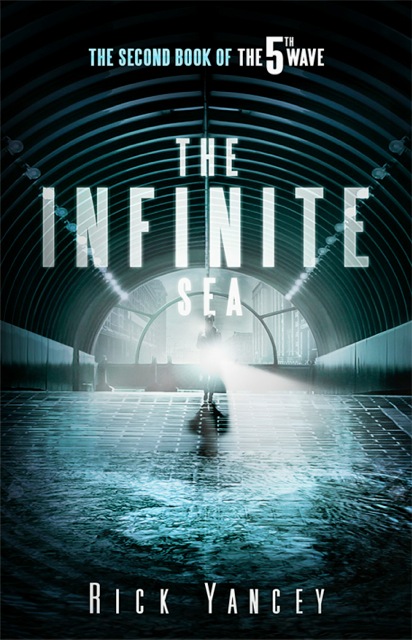
The Infinite Sea by Rick Yancey


Photo Sources:

Monday, November 23, 2015

One More Chance by Juan Miguel Sevilla

In which I try not to read in two different mindsets.


***


I am more accustomed to reading books that have been used as bases for movies. I remember worrying whether the existence of a film version is not good enough reason to read a book. But, looking at it now, the film could be a marketing strategy for the book, since books are always in stores, unlike movies, which don’t always stay in cinemas.

I recently had an experience that is the opposite of a novel-turned-movie phenomenon. Don’t get me wrong, I know that making novel versions of films isn’t a new concept. However, reading a book after watching the original film isn’t really something exciting for me. 

But one email is bound to change everything.

I was invited by Arlyn Rosales from ABS CBN Publishing to be part of a book discussion for the novel version of One More Chance, the hit 2007 romance starring Bea Alonzo and John Lloyd Cruz. I immediately said “yes.”

However, due to conflict in the schedule, the book discussion was cancelled. Instead, I received a package containing these beautiful things. 

Behold.


And with that, my initiation to reading novel versions of films began.

One More Chance (the novel) was written by Juan Miguel Sevilla, who was known for his screenplays for Star Cinema hits such as Miss You Like Crazy, My Amnesia Girl, and Unofficially Yours.

The novel opens with a prologue dedicated to memory, which honestly reminds me of Michelle Richmond’s The Year of Fog. Sevilla patiently describes Popoy’s recollection of how inconsistent memory could be, and how memorable falling in love for the first time is.

With his strong wordplay, Sevilla crafts expressions that both reflect the film while giving the novel a distinct personality -- expressions that will surely tug at the heartstrings of hopeless romantics. 

The plot unfolds like the movie itself, with some expected changes. And these are good changes that allowed the novel to offer a new, fresh perspective on the narrative.

But just like any novel and film that existed to complement each other, one inevitably stands out. And this time, it’s the movie. 

Sevilla wrote for the fans of the film, not for readers who haven’t watched it yet but still wanted to read a romantic novel. While the movie is vivid in all dimensions (let’s not even get started on how good Bea and john Lloyd portrayed their characters, the hugot lines that never got old, and the soundtrack, my goodness!), the novel seemed to be too caught up in the excitement to tell its own story. The film showed the viewers the metamorphosis of Popoy and Basha from lovers to strangers and back, making the viewers part of the journey. The novel reports that metamorphosis from the point of view of an editorial omniscient narrator.

Reading the novel is a very emotional roller coaster ride, and it’s not entirely because of prior knowledge. It always feels good to be allowed inside the character’s head and see his or her internal struggles. But sometimes, ignorance is truly bliss. Being given too much removes the challenge of understanding the characters and the complex human experience that they embody.

Several pages before the novel ends, and probably just when I thought I know exactly how the writer will choose to end the story, a surprise awaits. And it’s an emotional roller coaster ride once again.

***

Speaking of emotional hopeless romantic stuff, do not miss A Second Chance, the sequel to One More Chance on November 25 in cinemas.


Photo source:

One More Chance (the novel)

Wednesday, October 7, 2015

Analysis of "How My Brother Leon Brought Home A Wife" By Manuel E. Arguilla

In which the journey and the destination count.

***

When I first read "How My Brother Leon Brought Home A Wife," I was in fourth grade. And just like any fourth grader, it didn't mean anything to me. Or perhaps it did, albeit in a very shallow, childish way. I remember thinking that Maria is a clever and sweet girl when she called Leon Noel. See, it's Leon spelled backwards! Oh, the simple satisfaction of a child's discovery.

Reading it again several years after, proved to be more than an eye-opener. The short story is not just a recollection of an afternoon adventure with a brother's fiancé. It's a plan made with good intentions, but was executed with apparent cruelty.

The short story opened with a simple but direct (and quite pictorial) description of Maria.
She stepped down from the carretela of Ca Celin with a quick, delicate grace. She was lovely. She was tall. She looked up to my brother with a smile, and her forehead was on a level with his mouth. 
… Her nails were long, but they were not painted. She was fragrant like a morning when papayas are in bloom. And a small dimple appeared momently high on her right cheek.
From here, all the other descriptions sprang from Maria. Baldo, Leon's younger brother, see things only as Maria's periphery. The narrative flow becomes based on whatever Maria looks at, touches, or whoever comes near Maria. She seems to be a beautiful light source, and any object only becomes relevant when touched by her radiance.

Baldo was the one tasked to bring Leon and Maria to their house. But instead of following camino real (which I believe was the main road), Baldo guided Labang (the carabao) the other way -- back to where Ca Celin dropped them off and into the fields.

This is where things get mysterious … and awkward.
When I sent Labang down the deep cut that would take us to the dry bed of the Waig which could be used as a path to our place during the dry season, my brother Leon laid a hand on my shoulder and said sternly: 
"Who told you to drive through the fields tonight?" 
His hand was heavy on my shoulder, but I did not look at him or utter a word until we were on the rocky bottom of the Waig. 
"Baldo, you fool, answer me before I lay the rope of Labang on you. Why do you follow the Waig instead of the camino real?" 
His fingers bit into my shoulder. 
"Father, he told me to follow the Waig tonight, Manong." 
Swiftly, his hand fell away from my shoulder and he reached for the rope of Labang. Then my brother Leon laughed, and he sat back, and laughing still, he said: 
"And I suppose Father also told you to hitch Labang to the cart and meet us with him instead of with Castano and the calesa."
What's admirable in Leon's personality is his calmness. He might have already sensed that something is awry, yet, just like most Filipinos, he chose to dwell on positive things.
Without waiting for me to answer, he turned to her and said, "Maria, why do you think Father should do that, now?" He laughed and added, "Have you ever seen so many stars before?"
And so they looked at the stars, and sang. They still sang even after the cart's wheels hit a big rock. And Baldo noticed that Leon and Maria's world is no doubt full of happiness.

After realizing that they are getting nearer Leon's home, Maria expressed her fear that his father may not like her.

Upon reaching their house, Leon immediately looked for his father. But it was Baldo for whom the old man called.
"Did you meet anybody on the way?" he asked. 
"No, Father," I said. "Nobody passes through the Waig at night." 
He reached for his roll of tobacco and hitched himself up in the chair. 
"She is very beautiful, Father." 
"Was she afraid of Labang?" My father had not raised his voice, but the room seemed to resound with it. 
And again I saw her eyes on the long curving horns and the arm of my brother Leon around her shoulders. 
"No, Father, she was not afraid." 
"On the way---" 
"She looked at the stars, Father. And Manong Leon sang." 
"What did he sing?" 
"---Sky Sown with Stars... She sang with him." 
He was silent again.
When Leon and Maria entered the old man's room, Baldo was told to water Labang. And on his way out, he can’t help but notice Maria again.
I looked at Maria and she was lovely. She was tall. Beside my brother Leon, she was tall and very still. Then I went out, and in the darkened hall the fragrance of her was like a morning when papayas are in bloom.
The story started and ended in the description of the same person. It is easy to think that the story isn't about Leon. It is about Maria.

In fact, the road Leon's father told Baldo to take is also for Maria. If one considers how Baldo and Leon had difficulty in tying Labang to the cart, and even guiding him to the part where the camino real curves (because Labang wanted to go straight on), it is very apparent that even the animal isn't used to taking that road.

Why the old man decided that the visitor ride on the hay in a cart (in her high heels) and pass by the field instead of a more comfortable calesa in a shorter road isn't answered. The interrogation of Baldo (which doesn't provide straight answers, too) seemed to be inevitable, but nonetheless significant.

The epiphany in the story is very subtle. The falling action quite abrupt. What could remain in the readers' minds is the question of how Maria would keep her composure in front of the old man considering the journey they have just taken. She doesn't appear to have enough time to gather her thoughts and feeling, any more than she has time to rest.

And in the end. That's what the old man wants -- to see her for what she really is.

In his novel The Winner Stands Alone, Paulo Coelho wrote, “Life has many ways of testing a person's will, either by having nothing happen at all or by having everything happen all at once.” He implies that life is full of surprises. And a person's character is reflected by his or her reactions for both scenarios.

In Maria's case, everything seemed to happen all at once: her desire to look the best she could, only to be part of an uncomfortable journey, and then face a man whom everybody seemed to be scared of.

Instead of complaining, she spoke calmly, remained full of gaiety and laughter and finesse, and admired the beauty of nature that Ermita is forever bereft. She may not have gone through the tests of Psyche and Savitri, but in her own difficult journey, she stood out for what she really is -- a beautiful woman inside and out.