Sunday, December 2, 2012

Rise of the Guardians by DreamWorks


(In which it pays to find your center.)

***

I have always been very fond of animated movies, a penchant that wouldn't go unnoticed to some serious grownups. I don't know. It could be due to the uncontrollable kid in me or just the sheer fun of seeing cinematic things that are best left to Pixar and DreamWorks characters because they'll look awkward when done by humans. Take, for example, some incredulous anime-turned-live-action series.
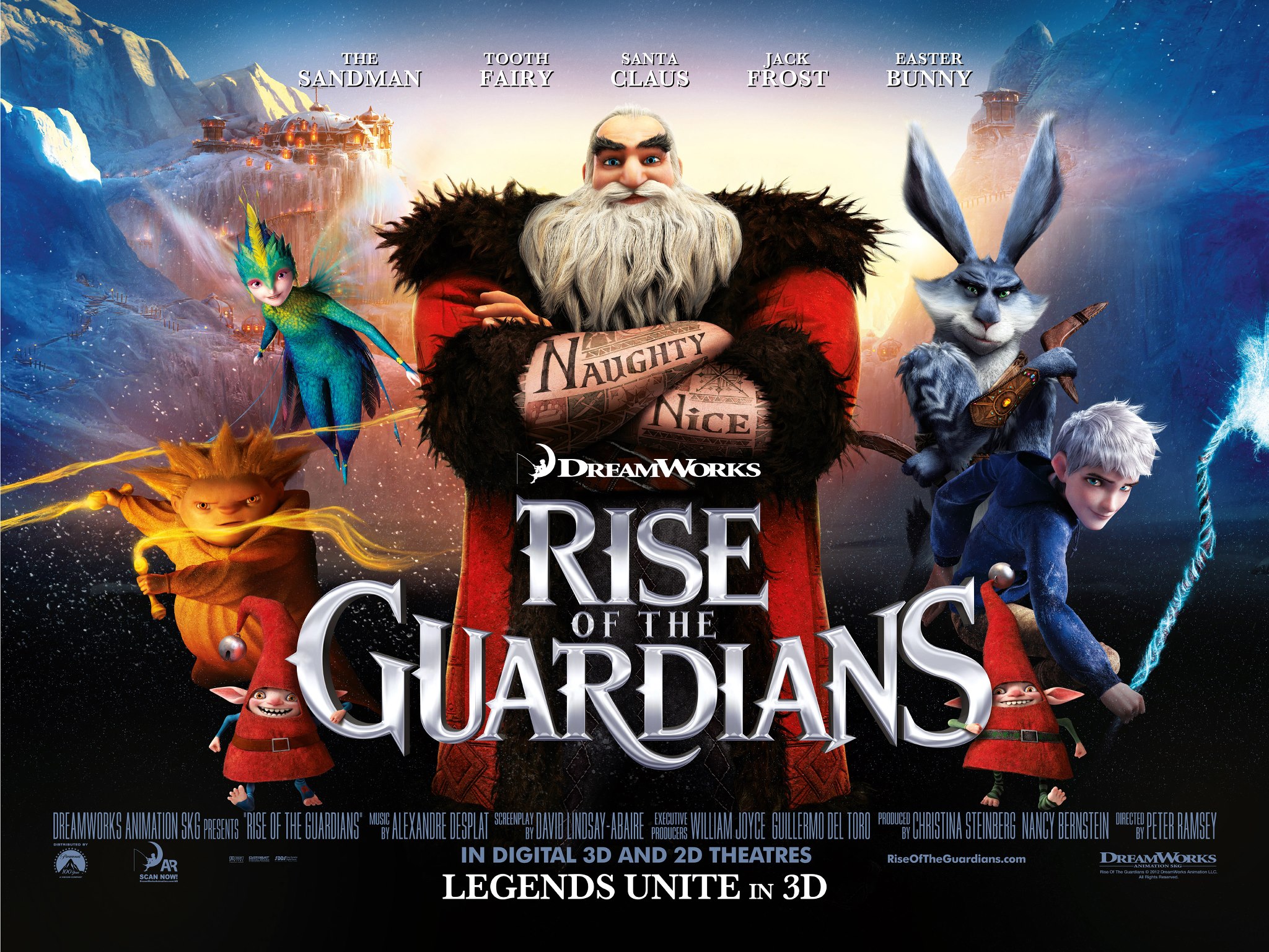

The latest of my animated film experience is Rise of the Guardians, a concoction of some of the biggest names in children's myths, namely Santa Claus (Alec Baldwin), the Easter Bunny (Hugh Jackman), Tooth Fairy (Isla Fisher), Sandman and Jack Frost (Chris Pine). Add to that the omniscient Man in Moon, and you've got The Guardians,  DC’s Justice League and Marvel's The Avengers fantasy equivalent. But unlike their classic superhero counterparts, the Guardians only cater to kids. Besides, people outgrow Santa faster than they outgrow the Dark Knight.

So it is for the believers that the Guardians exist. There were originally four of them. But when Pitch Black the Boogeyman (Jude Law) threatens to fill children with fear and disbelief in the Guardians, Man in Moon has to choose another protector, Jack Frost. There were some problems, however. Jack doesn't want to be a Guardian, the children do not know him, and therefore do not believe and he doesn't know who he is and how he came to be. And for him to answer all his questions, Jack has to work with the Guardians to defeat the Boogeyman and retrieve the children's precious memories which he stole - along with Jack's.

It may sound like a predictable plot, and it is, unfortunately. Even after the epiphany kicks in, the effects are somewhat delayed. And the Christmas theme is somewhat lacking, the only obvious signs of which are snowflakes and Santa Claus. And just when I thought the main issue it will solve is “Do you believe in Santa Claus? You better do!”, there goes the likes of “Who on earth is Jack Frost?” and “Do you believe in Santa Claus? If you do, then you have to believe in all of them!” Apparently, it’s hard to focus.

But if there was one remarkable thing that stood out in the movie apart from Santa’s thick accent, or Jack Frost being very handsome, or Tooth Fairy’s obvious attraction to Jack, or Sandman’s incomprehensible reappearance, it’s the film’s bold negation to the widely accepted grownup saying “to see is to believe”. In the film, only the believers see the Guardians, hence the negation. Its reliance on children’s innocence is so refreshing you’ll be tempted to believe in the unbelievable again. 

Rise of the Guardians is DreamWorks Animation’s attempt to take down the hot conclusion of the Twilight saga. Quite ambitious, yes. But whether Jack Frost can overpower Edward Cullen or not, I know you’ll watch this animated movie. How do I know? If I may borrow Jack Frost’s opening and closing lines, because the moon told me so.

Photo source:

Sunday, November 4, 2012

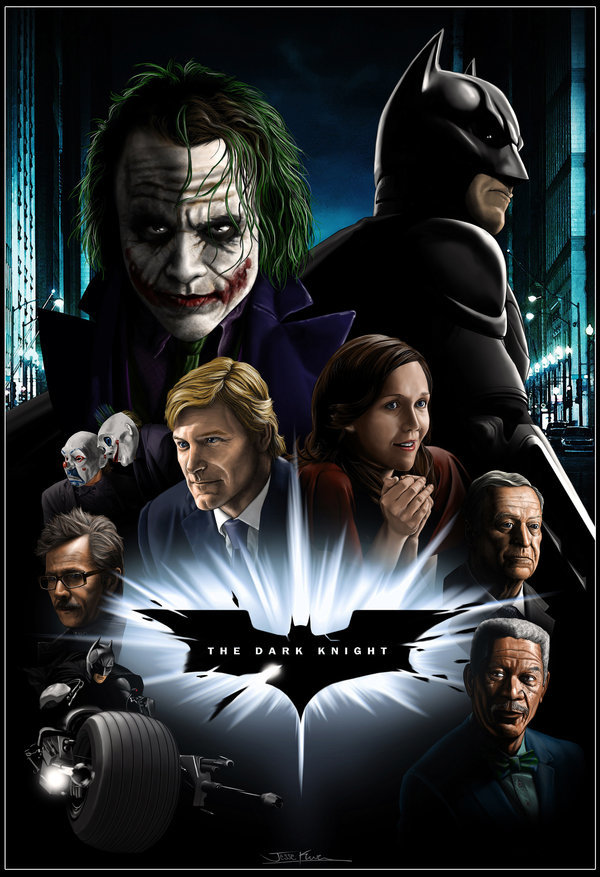
The Batman Trilogy by Christopher Nolan


(In which it is still better late than never.)

***

For those few who were wondering why on earth there is a movie review in here, I believe I owe this blog anything my amateurish writing skill can offer. And yes there are other movie reviews here. Help yourself.

One belief I have when it comes to watching movies (and reading books, except for one) that come in series is that I have to see the prequels first. I know I have been missing a lot of good stuff out there, but with a teaching career, studies and a social life I need to redeem, can you really blame me? Fortunately, no one has to. Because I myself have suffered too much disappointment upon failing to catch The Batman Trilogy in cinemas. Instead I had to make do with not-so-clear copies (I'm not complaining; just stating facts) to stop making myself unforgivably ignorant about the hunk that is Christian Bale. Seriously, I stopped minding that unlikely voice he has whenever he's wearing the suit by the second installment. He's that disarmingly charming.

Anyway, in celebration of the trilogies I've featured in one full blast (which I believe is more difficult than installments. Time management training needed), here's what I got from my precious digital copies.

In Batman Begins (2005), Bruce Wayne (Christian Bale) is a ridiculuously rich kid in Gotham City who got orphaned after his parents were killed by a random holduper. He left his wealthy status and lived with the thugs until he landed in a prisoner where he met Henri Ducard (Liam Neeson). Ducard sees Bruce's fighting skills as a huge asset that Bruce was taking for granted. He invited Bruce to be part of Ra's Al Ghul's League of Shadows whose main purpose is to alleviate societies of crimes and injustice. Bruce was trained to master his fears and become a better fighter. But when the training ends and his true initiation begins, Bruce finds out it's better to rebel than to yield.

He goes back to Gotham City and assumes the status his inheritance endows him. And with the resources and connection, he starts building the technology and materials to alleviate Gotham of crimes and injustice - as The Batman. But his journey as a black-clad vigilante doesn't happen without risking the lives of people he values - such as his beloved childhood friend Rachel Dawes (Katie Holmes).

In The Dark Knight (2008), Bruce Wayne comes face-to-face with Rachel's (Maggie Gylenhaal) new boyfriend, Harvey Dent (Aaron Eckhart). He continues to try to win Rachel by clinging to what she said about them being together when Gotham no longer needs Batman. By this time, a new villain is plaguing the city - the psychopathic evil that is The Joker (Heath Ledger). In their seemingly never-ending chase, Bruce was torn between keeping his identity as The Batman and giving himself in to stop The Joker from killing innocent people. And because of one important decision, Bruce lost two friends.

In The Dark Knight Rises (2012), eight years after being shattered by two deaths, Bruce lives a life in seclusion until he stumbles upon The Cat Burglar (Anne Hathaway). It turns out that she stole his finger prints for someone who wants to take over Wayne Enterprise. Meanwhile. Bane (Tom Hardy) goes to Gotham as the heir of The League of Shadows devoted to punish Bruce for his betrayal. With Batman captured and Gotham city ruled by Bane who threatens to blow it up via an atomic bomb, Bruce and other righteous citizens strive to put order in a chaotic, rules-less society. Just when they thought they've got the bomb detonated, someone blurted one final surprise. 

As you can see, it's hard to put the spoilers out for the sake of those who haven't seen it. 

Anyway, if there's one thing that amazes me about the movie apart from the awesome black vehicles and Christian Bale, it's the movie's knack for hair-raising surprises. I don't know. But for someone who (shamefully, again) missed the comic books and some episodes in the animated series, those shockers were priceless. 

I also have to admit that as a superhero, Batman is incredibly human. I mean, his faults, his shortcomings and short-sightedness were justified either by his upbringing, downfall, fears and privilege, or perhaps a mixture of all those. He was predictable and unpredictable at the same time. His compassion and martyrdom were commendable. yes. But what's more noteworthy is his belief in humanity. Heroes are all meant to salvage and redeem. But not all intend to let the people they save be heroes for themselves.

So yes. The trilogy's a good movie that has shamefully been missed.

Now, I'm on my way to googling that cheer the prisoners shout in the pit.

Photo Sources:

Friday, November 2, 2012

His Dark Materials Trilogy by Philip Pullman


(In which destiny’s capacity for betrayal never ceases.)

***

When I decided to slip The Golden Compass (Book 1 of the trilogy) for Brit lit along with the Hunger Games for Am lit into the roster of literary text for my World lit subject, I just had one thought in mind: I wanted my students to see their common ground – the influence of an overly dominating social entity (the Capitol in Collins’ and the Magisterium in Pullman’s) and the consequences of absolute power. Incredulously simple, isn’t it? 

Although I was worried because of the anti-religious theme of The Golden Compass, the fact that Chaucer’s The Pardoner’s Tale and Alighieri’s The Divine Comedy made it to the original list boost my confidence in this rather audacious decision. There would be no harm in teaching The Golden Compass, I thought. But I’m certain The Subtle Knife (Book 2) and The Amber Spyglass (Book 3) mean a different story. 

After a semester, I believe the lessons are successful. Okay, just so-so. Whether or not my own personally-chosen inclusions would make the students want to read more than The Perks of Being a Wallflower and The Fifty Shades Trilogy (which, shamefully, I still haven’t read) was beyond my basic clairvoyance or tests. But anyway, am I not supposed to be glad about those titles?

I was able to finish the remaining half of the last book of His Dark Materials Trilogy after almost two months of grappling with academic paperwork, And then I realized, my students should read the whole series. Never mind the anti-religious theme Pullman confirmed. The book is more than just multiple parallel universes. It’s even more than just simply doing what’s right and fulfilling your dreams.

Set in Oxford in another world, The Golden Compass opens into a dimension in which humans walk beside their souls in the form of animals, called daemons. One remarkable child, Lyra Belacqua, is among those simple kids who spend time frolicking in meadows and playing war outside Jordan College. But things go awry when one by one, children start to disappear. Lyra’s simple childish life turns to a halt when she hears about Dust. She was also chosen as an expedition assistant by Mrs. Coulter and was given the alethiometer, a truth measurer, by the Master of Jordan College. After doubting Mrs. Coulter’s intentions, Lyra runs away and was rescued by the Gyptians. With the help of the alethiometer and the Gyptians, Lyra sets out to find her best friend Roger, who is also among the missing children kidnapped by the evil that was the Gobblers, headed by Mrs. Coulter. To accomplish this, Lyra needed the help of various people and creatures – the witch queen Serafina Pekkala, Lee Scoresby the aeronaut and the armored bear Iorek Byrnison. Just when she thought her duty ended with the rescuing of the kids, her uncle Lord Asriel opened a portal to a new world.

In The Subtle Knife, Lyra enters the gate to another world and finds herself in Cittagazze, where she meets William Parry, a boy from the world we know. Cittagazze is inhabited mostly by children. The adults either flee or die because of the Specters. William acquires the subtle knife, an instrument that scares the Specters. One of its edges cuts through any solid and the other cuts a window through any other world. By this time, Lord Asriel has started to make an army to rebel against the Authority in the heavens. He is after Will and Lyra because of the prophecy about the children and because of the subtle knife, a potent weapon in achieving a world without the Magisterium and the Authority. Different creatures from different worlds cross the windows cut by the knife to join the biggest war in the universes.

The Amber Spyglass concludes with answers regarding the prophecy about the children and the true nature and origin of Dust. The great battle was fought and in the midst of smoke and war, Lyra and Will find themselves in love, only to be ambushed by the horrific truths about the subtle knife and the alethiometer, as well as the decision they have to make to save Dust and stop the universes from falling apart.  

So the supposedly cliché coming-of-age themes of finding one’s identity and realizing one’s worth and destiny open up to a heavier premise for the novel, what with all the clash between science and religion made more complex by morality and ethics. Never mind the colossal war that sort of fell short with the greatness it was supposed to be. The novel is a great surprise in itself. I gave up expecting love to unfold anywhere after the first book. But when it did happen, it hit me hard with the intensity of high school romance.

When I started teaching The Golden Compass, I was only after making the students check on what social (whether religious or political) entity moves a society, a nation or a world, and to what extent the greed for power and supremacy leads people. I asked my students what a parallel universe is. In my head I picture this:


Now I realized it should have been (with the major differences and all) this:


I know I have said too much.


Currently reading:                                            


Photo Sources: